Wednesday, September 21, 2016

Brand Spotlight: Wear Moi


Wear Moi is a French brand that has become popular worldwide.  Beautiful leotards and unique warm-ups are Wear Moi’s most popular products.


pronunciation
Wear-mwah
website
wearmoi.us/en (English/US), wearmoi.com (worldwide home, in French)
styles of dance included
ballet, pointe, jazz, modern/lyrical/contemporary
types of items
bodywear, shoes, warm-ups, accessories
country of origin
France
price point
lower-end Luxury
quality
excellent
availability
Somewhat available at local dancewear stores in the US and abroad, good selection on discountdance.com, full selection on official website (can order online and ship to most countries)
sizing
Leotards run true to size, but shallow in bust and bottom. (For reference, I am 5’4” 99 lbs with long torso, and I wear a small.)  I have not tried on any Wear Moi shoes.
Jillian’s top pick
Mabel, Kyara, and Odette Leotards
Jillian’s item to avoid
None to speak of

Sunday, September 18, 2016

Help! My hair is too short for a bun!


Is your bob or pixie cut too short for a ballet bun?  Don't despair.  There are many ways to wear your hair so it meets the requirements for the given situation.  My hair is super thin, and I prefer to wear my hair around shoulder length.  My buns are often pretty small.  I use many tricks of the trade to keep my hair in place.

Before we discuss solutions, let's get into a little bit of "why."  Why do ballet dancers wear their hair in buns in the first place?  This hairstyle ensures that a dancer's hair will not hit her in the face when she turns.  A bun placed on the crown of the head can also theoretically improve balance since it is in the center of the head and does not add weight to one side of the body or another.  For most situations, it's more important that you keep your hair out of your face and in a balanced style than actually creating the bun.

If the uniform for your ballet class specifies that your hair must be in a bun, you can probably just fix your hair so it is neatly pulled back away from your face (but check with your teacher to make sure she's ok with it).  Spray your hair with water or leave-in conditioner, and put it  in a ponytail if it is long enough.  If your ponytail sticks straight out and/or does not hit you in the face when you turn, that's all you need to do.  Add a few clips or bobby pins around the sides to make sure stray strands don't start to fall out.  If your hair is too short for a ponytail, use clips and bobby pins to pull your hair back away from your face.  Finish with a spritz of hairspray to keep everything in place when you start moving.

For performances, you will almost certainly need to wear a hairpiece.  Different looks are needed for different occasions, so you will need to talk with your teachers, the artistic director, and the costumer to make sure you know what is needed for your part.  If you are a party boy in Nutcracker, you may not need to fix your hair at all, but if you are performing in the corps of Swan Lake, you will need to create a fake bun.  If you are the lead in Alice in Wonderland and need to have long hair around your shoulders, you will need to use a different hairpiece or even wear a wig.

If you need to create a fake bun, you have a few options.  For all of them, your hair needs to be long enough to create a ponytail (or at least a "half-up" ponytail with the top portion of your hair).  If your hair is not long enough to make even a baby pony, try to let it grow as much as possible before the show. 


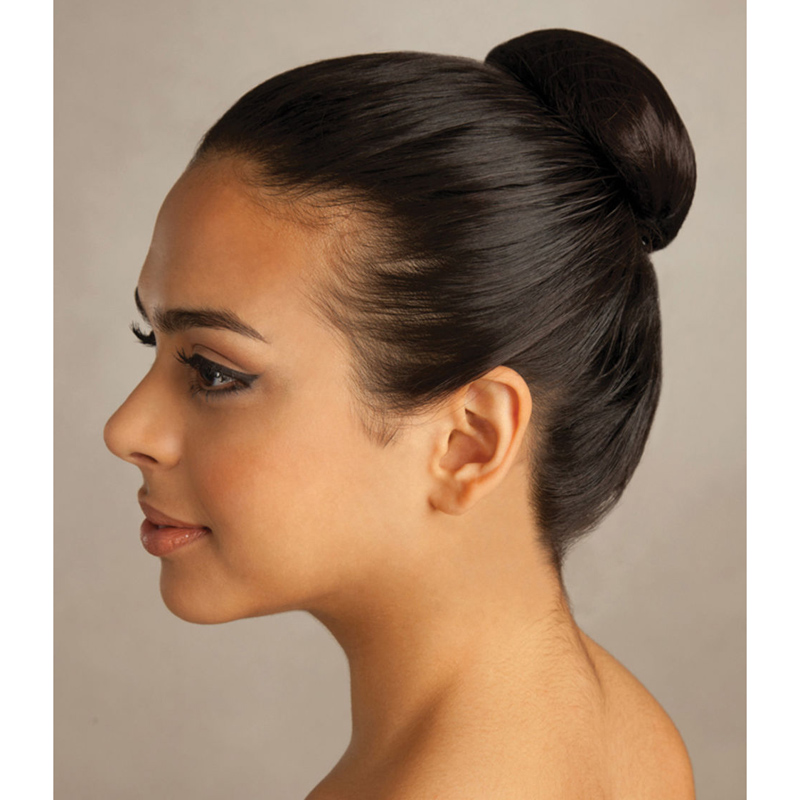
Option 1 is a donut or "bun maker."  These can be purchased at Claire's Accessories stores, beauty supply stores, some dancewear stores, and online.  Claire's Accessories carries donuts in many colors and sizes, including very tiny ones with diameters of about 2.5 inches.  If your ponytail is long enough, slip the donut over your ponytail and wrap the ponytail down to cover the donut.  Secure the hair around the donut with bobby pins, and use pins and hairspray to clean up any "fuzzies" around the sides or at your neck.  If you have ethnic, textured, or very curly hair, the mesh donut texture can appear to match your hair texture from a stage distance.  You can secure the donut to your hair with pins without worrying about wrapping your hair around it completely. 


Option 2 is a pre-made fake bun.  You can purchase a fake bun online (Capezio/bunheads makes a product called the Allegro Bun, available on discountdance.com) or at a wig store.  To arrange a fake bun, put your hair in a ponytail and use bobby pins to attach the fake bun to your hair on top of the ponytail.  Fake buns look very realistic and take less effort on your part, but they can be heavy and are only "good" for a handful of uses before they start to look a little sad.  Most fake buns cannot be disassembled and brushed out.  They cannot look new again once they are used.


Option 3 is using a switch (fake ponytail) to create a bun.  This option is also excellent for dancers with thin hair or hair that wraps to a very small bun (like me).  You can purchase a switch at a wig store, or you can make your own by purchasing an elastic band hairpiece (I like the brand "Dancing with the Stars" that is available at Sally Beauty and Ulta stores) and carefully cutting the elastic.  This will leave you with a long elastic string with hair attached to the length of it.  Use a needle and thread to reinforce the stitching that holds the hair to the elastic band at each end.  DO NOT purchase a cheap "fashion" hair piece or fake ponytail from Asian-based retailers online; this will leave you with a very heavy and overly long poor quality plastic hair piece that will be very difficult to attach to your natural hair and wrap into a bun.

To create the bun, put your hair in a ponytail and attach the switch to your ponytail (it's easiest to tuck it into your elastic).  Depending on how long the switch is, you can choose to attach it at one end or at the middle of the length of the hair.  Twist the switch so it wraps up your natural hair in the fake hair, and wrap it into a bun.  Pin in place with bobby pins, and follow with a hair net to keep any little pieces from sticking out.  I prefer this method because the bun looks very realistic, it's not hard to wrap, and the switch can be brushed and washed so it always looks nice.

If you need advice about styling your hair for any dance occasion, don't hesitate to ask in the comments below!

Wednesday, September 14, 2016

Pointe shoe myth vs. fact


1.  Pointe shoes last only one hour.  

Myth, kind of.  How long pointe shoes last depends on a huge number of factors including the dancer’s strength/level, the difficulty of the choreography, the climate, the brand and construction of the shoe, and how the dancer likes the shoe to feel.  Some shoes, such as Freed Grand Classics, are made of extremely degradable materials in order to perfectly fit an individual dancer for just a short amount of time.  Dancers who like Freeds may wear a new pair each day in class, and up to one pair per act when performing in ballets.  In this case, a shoe may last just one hour.  Other shoes, like Gaynor Mindens, are made of strong and resilient plastics so they can be worn for months with little degradation.  Most traditional paste pointe shoes (Grishko, Bloch, etc.) that have the appropriate strength of shank for the dancer’s level last between 12 and 24 hours of wear, which works out to approximately 3-4 months for a beginning student, 1-2 months for an intermediate student, and about 2 days for a professional.

2.  All dancers get disfigured feet from wearing pointe shoes.  

Myth, again, kind of.  It is possible to get foot disfigurements from pointe shoes, but that does not mean that it happens in all cases.  Professional fittings and proper padding can prevent most of the common issues that caused foot disfigurements in years past.  (In “the olden days,” dancers often wore pointe shoes that were too tapered and used minimal padding.  Professional fittings were few and far between, and most dancers went for aesthetics rather than function.  This resulted in the severe bunions and hammer toes that are frequently associated with ballet dancers.)  Most dancers who have been en pointe for several years will experience mild bunions and foot widening, as well as occasional blisters and callouses.  These are not disfigurements, but natural changes that happen when the feet strengthen with years of pointe.  Severe bunions, constant blisters, and other problems are the mark of an ill-fitting shoe.  Usually getting re-fit in a different shoe with a better fit will prevent most major foot problems.

3.  Dancing en pointe hurts.  

Fact, but maybe not as bad as you think.  A better way to describe it is as uncomfortable.  Maybe this will help non-dancers get the picture:  your arms ache after doing a lot of push-ups, your bruised knee throbs when you hit it on something, and your hand cramps up when hand-writing a long letter.  Working en pointe causes lots of muscle fatigue, which is not usually a good feeling.  Pointe also sometimes causes minor injuries like a bruised toenail or blister, and the shoes’ tight fit can lead to feet feeling smushed after a long rehearsal.  These things cause pain, but not severe pain.  Most pointe-related pains feel like other pains you get in your day-to-day life and would normally work through. 
If you do feel severe pain en pointe, then your shoes do not fit correctly.  It is common for dancers’ feet to change with physical growth and improved technique, so if your pointe shoes begin to cause huge pains after you have been wearing the same brand for a while, you may want to get refit in something different.  There are also many toe pads, spacers, tapes, and other things you can use to reduce pain in your shoes.

4.  If my friend and I have the same shoe size, we will wear the same pointe shoes.  

Myth. Huge, mega, bigtime myth.  I don’t know how many times I have had dancers ask if they can try a Grishko 2007 because their best friend has one.  It’s not bad to ask other dancers what shoes they wear and what they like/dislike about them, but you can’t take this information and apply it to yourself without considering your individual characteristics and needs.  Two dancers may wear the same size in regular street shoes, but this does not mean that their feet are similar at all.  One might have a wide foot, the other may have narrower feet.  One may be more tapered, bunion-prone, stronger, etc. than the other.  All of these factors (and more) contribute to what size, model, brand, etc you need in a pointe shoe.  It is highly unlikely that you will wear exactly the same shoe down to model and size as any other dancer in your class. 

5.  Barbie ballet movies show ballet and pointe accurately. 

Mostly fact, but with a few bigtime exceptions.  The Nutcracker, Swan Lake, and The Pink Shoes were all animated based on video of professional dancers performing the variations included in the films.  All of the dancing, including how a dancer moves en pointe, is pretty accurate (at least as accurate as it can be in gumby-ish computer animation).  The parts of The Pink Shoes (opening credits, I think?) that show dancers putting on pointe shoes and warming up are pretty accurate.  However, the parts of The Pink Shoes that show dance company life are immensely inaccurate and oversimplified.  

6.   I need to manually break in my pointe shoes before I wear them.  

Myth.  The important words here are “manually” and “need to.”  You do not need to break in your pointe shoes before you wear them by using your hands or other objects to smush or bash your shoes.  First time pointe students should not do anything to their shoes without a teacher’s permission and supervision.  For your first few pairs, it is very beneficial to let your feet do the work of breaking in.  Even advanced students and professionals do not need to manually break in their shoes; it is possible (and still beneficial) to let your feet do the breaking in.  However, it is also totally fine to manually break them in if you know what you are doing.  Just remember that not all shoes break in the same way, so something that works on one type of shoe may not work so well on another.  It is possible to destroy pointe shoes if you break them in too much or in the wrong ways, so refrain from manually breaking and ask for help if you are unsure.


7.  Only girls do pointe.  

Myth.  You may see only female dancers between ages 10 and 30 with pointe shoes on, but male dancers sometimes do pointe, and older adult dancers frequently do pointe as well.  Pointework is wonderful for strengthening the feet and ankles, so for trained dancers, it can be practiced as a form of exercise.  Some male and older adult dancers choose to work en pointe for this reason.  Male dancers can also perform character roles that require them to be en pointe, such as Bottom in A Midsummer Night’s Dream and the ugly stepsisters in Cinderella.  Community dance theaters with only a few annual performances are ideal for younger students, retired professionals, and dancers who began later in life to perform roles en pointe.

Sunday, September 11, 2016

Tough social situations at the dance studio


The social atmosphere in the studio is simultaneously the same and very different from the social atmospheres at school, in the office, and at home.  Students often act the same way toward their friends and teachers at the dance school as they do toward their friends and teachers at academic school or toward their siblings and parents at home.  Because dance is a visual art, everyone's triumphs and struggles are much more apparent than they are in a classroom or office setting.  This can lead to some awkward situations that often result in inappropriate behavior.  In this guide, I will lay out some common happenings and explain the best ways to react.

(Note:  I have seen some of these situations play out in real life.  I am NOT telling exact firsthand stories, and the names I have assigned the '"characters" are generic ones meant to make the situations easier to follow.)

1.       Cara and Chris are making fun of how Sam landed his pirouette.  It looks like Sam messed up.  Are Cara and Chris being mean?  Is it ok for you to laugh too?

It can be uncomfortable when dancers are making fun of others, but sometimes this kind of teasing is not malicious.  If Cara, Chris, and Sam are all friends; Sam is laughing too; they would probably laugh or behave similarly if someone else made the same mistake; and the mistake was a rare, genuinely comical error, then everything is fine.  Cara and Chris are not being mean.  It's ok for you to laugh too.

If Cara and Chris are not friends with Sam, they would probably not laugh at someone else, Sam seems hurt or upset, or Sam makes a lot of mistakes like that, then Cara and Chris are not being kind.  You should not join in.

2.       Tammy practices different steps and movements all the time during class, even when the teacher is giving instructions.  Is she disrespecting the teacher?  Is it ok for you to do that too?

If Tammy is briefly working on a step she messed up in the last combination or doing a generic, easy movement like balancing on one foot, it's fine that she keeps moving.  If she is looking at the teacher, she is probably listening and getting the information she needs for the next part of class.  It's ok for you to do that too as long as you are paying attention to the teacher and not infringing on anyone else's space.  If the teacher asks you to stop or pay closer attention, do so immediately.

If Tammy is doing large jumps or pirouettes, infringing on others' space, or ignoring the teacher so that she is lost during the next combination, she is being disrespectful.  Do not follow her example.

3.       Joe, one of the most advanced dancers, just executed a combination very well.  Should  you clap or congratulate him?  Is it ok that you feel jealous?

If Joe is humbly pleased with his performance, he absolutely deserves praise.  If the rest of the class is clapping, join in.  If you are friends with Joe and know his performance was truly stellar for him, personally tell him it he did a good job.  It's absolutely ok to feel a tiny bit jealous, but don't let it hurt your relationship.  Rather than thinking about how good of a dancer Joe is, try to notice things in his technique that make him successful (like snappy spotting making pirouettes look sharp).  Try to apply these things to your own technique.

If Joe is acting stuck up or is otherwise begging for compliments after his successful combination, you should still clap if everyone else does.  Don't feel obligated to give him a personal compliment, though.  Make a mental note to remain humble after you give great performances.

4.       Sara, one of the less advanced dancers, just did a good double pirouette.  This is excellent for her, but is below the level of most of the rest of the class.  Should you give her a compliment?  Or will that make her feel bad?

If you are friends with Sara, compliment her quietly when you have a moment between combinations or after class.  She will probably feel good knowing that you noticed her success.  Yelling out "good job" in front of everyone else may emphasize her level and embarrass her, so it's best to wait to compliment her.

If you're not friends, it's your choice if you want to compliment her or not.  Regardless of your relationship, never make any rude comments (like, "Sara FINALLY got her double"); this will undoubtedly make her feel bad. 

5.       Nancy, a senior student, is teaching a piece of her own choreography for the show.  One section of the choreography feels awkward to you, and you'd don't like it.  Is it ok to tell her?

If you feel comfortable, ask Nancy to go over the section again.  Tell her that you would like more direction on musicality or emotion.  This may make it feel less awkward, and it will let her know that you are having trouble connecting with that section.  At this point, Nancy is the choreographer and you are the dancer, and you both need to stick to your roles (even if you are the same age or in the same level).  Telling her directly (without her asking) that you don't like the choreography is out of line.

If you and Nancy are friends  and she asks you personally if you like her choreography, feel free to respectfully say that you don't like that section.  Don't offer advice on how to improve it unless she asks. 

6.       You are telling Ella about the blisters you got from the pointe classes at your summer intensive.  Ella insists that she got worse blisters at her summer intensive.  You think she might be lying or exaggerating.  Should you give her another example of how your program was more difficult or intense?

If you are friends with Ella and/or know her to be competitive, don't encourage her to keep "one-upping" you by continuing the conversation.  Switch to telling her something you loved about your intensive, or say that you both probably improved your pointework with your difficult intensive classes. 

If you are not friends with Ella, or if she is annoying you, just say something like , "Oh, ok," and let the subject go.  She probably wants to keep arguing about whose program was more difficult, so this should stop her from continuing.  Remember that if Ella is lying, nothing she is saying really matters, and you have nothing to prove by arguing with her.  Move on and try not to let her statements bother you.

7.       Cast lists are up!  Emily is one of the most advanced students, and she frequently gets big parts in ballets.  She has been cast as the lead in the upcoming show.  Jessie is less advanced, and she wasn't cast at all.  You got a smaller part in the ballet, which is consistent with your level.  Should you feel jealous of Emily?  Should you feel bad for Jessie?

If Emily is acting humble and/or you are friends, it's appropriate to congratulate her.  If you have class together or if you see her, quietly saying "congratulations" is the right thing to do.  As with Joe's example above, take Emily's technique as a an example of excellence, and try to incorporate some of her attributes into your own dancing.  It's ok to feel a little jealous, but don't let it change how you treat her.

If Emily is acting stuck up or you not friends, you should still say congratulations (in a kind, heartfelt way, not a mean way)if you see her.  You do not have to be excited for her, but you do have to behave nicely or neutrally toward her.  You are in the show together after all.

If you are friends with Jessie, acknowledge the situation by saying something like, "I'm sad that we aren't in the show together.  Maybe we will be next season."  Don't mention her level  unless Jessie brings it up first.  Try to cheer her up by hanging out outside of dance.

If you aren't friends with Jessie , don't say anything to her.  She could interpret it as malicious if you suddenly express sympathy that she wasn't cast when you usually don't talk to each other.  Never say anything condescending about Jessie or her abilities.

8.       Abby is having trouble with her balance in arabesque.  You are beside her, and you can tell exactly what she is doing wrong.  Should you tell her?

If you and Abby are friends and you regularly help each other out with out any frustration, you should tell her.   If she asks you for advice or says something like "I just couldn't get it," you can tell her what needs fixing.  Just be sure to stay positive.  Don't insinuate that she should have known better or that she was doing a bad job/not trying.

If Abby has a history of getting frustrated when criticized, it's better to stay quiet.  If you generally don't talk to each other or if Abby is older or more advanced than you are, it's also better to stay quiet.  Your correction, though well-meaning, can be interpreted as a an insult.  It's the teacher's job to give corrections, so it could seem like you are trying to say that you are above Abby or even above the teacher.

9.       You misplaced your black skirt at the studio last week.  In class today, you see Mia wearing a black skirt that looks like yours.  Should you confront her?

You should kindly ask Mia about it, regardless of your relationship.  Say, "I lost my skirt like that last week.  You didn't accidentally pick it up, did you?"  If you know your skirt has your name it or has another distinguishing detail, ask to check it out.  If Mia refuses, ask a teacher or other adult to mediate the situation and help you take a look at the skirt.  If it turns out to be yours, ask (or kindly insist) to have it back.  Thank Mia and forgive her for her mistake.  (Even if you think she took it on purpose, don't be accusatory in front of her.  You can talk to a parent or teacher about it later.) 

If it turns out not to be your skirt, apologize and move on.  If it's impossible to tell (you know a few people in class have exactly the same garment), don't push the issue.  Thank Mia for letting you look and move on.  Don't hold it against her, but stay aware if any other items go missing.

10.   The teacher always gives Ryan a lot of compliments in class.  Betty rarely gets compliments, and the teacher is always correcting her.  You get a good balance of corrections and compliments.  Should you be jealous of Ryan?  Should you feel bad for Betty?

It's natural to want to be complimented, so jealousy and sympathy are common emotions in this situation.  If the teacher is inexperienced, she may not realize that she is giving un-balanced feedback.  However, the teacher may be doing this on purpose.  She may know that Ryan needs a lot of encouragement to give his best effort.  Betty may want to train professionally, in which case she needs a stricter program than other students.  Regardless of the teacher's intent, it's not your place to decide who needs to be complimented.

If you are friends with Betty and you notice she seems down about getting corrected, give her a personal compliment after class every once in a while.  You can also encourage her to speak privately with the teacher and express a desire to have her successes acknowledged alongside her errors.

Wednesday, September 7, 2016

What is the difference between a ballet leotard and a gymnastics leotard?


I’ve seen it happen all too often.  A parent signs her daughter up for gymnastics classes, then goes to the dancewear store to find a leotard.  However, every beautiful shimmering piece the sales girl offers costs at least $45 and that’s too much to spend on a 3-year-old’s outfit when she may quit after the first lesson.  There is a rack of perfectly good cotton leotards a few feet over, and they only cost $15, so that is what the little one will wear to her first gymnastics class. 

It also happens the other way around. A parent takes her toddler to the dancewear store to find an outfit for ballet.  Even though all the other dancers will be wearing neat cotton leotards, the young dancer demands the glittery purple gymnastics leo and ends up going to class dressed inappropriately. 

Situations like these could easily be avoided if parents and dancers understood the differences between leotards meant for different activities. (I don’t blame anyone for not knowing the difference; I just want to help dancers and their parents have a deeper understanding of dance and dancewear.)   A combination of tradition, aesthetics, and function denote what students should wear for each activity.  Wearing the appropriate leotard is important as it shows discipline, respect for the activity, reduces distractions, and enhances the child’s ability to fully participate.

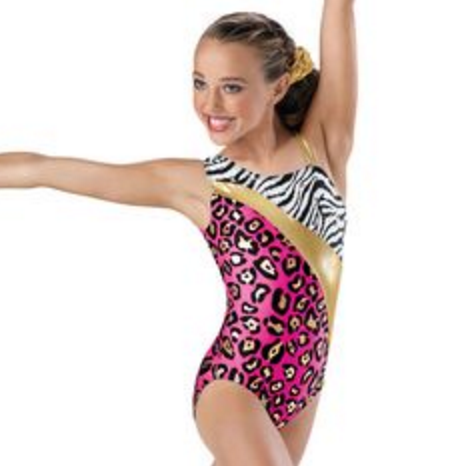
Gymnastics leotards are always made of shiny spandex or velvet material and come in two cuts: tank and long sleeve.  Usually students wear tank leotards for lessons and practice and long sleeves for competitions and performances.  A young girl taking gymnastics for the first time should get a tank style leotard.  Gymnastics leotards also usually come in very bright colors and fancy patterns.  Sometimes shorts unitards (bodywear garments that have a bike-short like bottom instead of a brief “underwear” cut) are also appropriate for gymnastics, but I recommend getting a leotard for the first class.  Shorts can be worn over if the dress code allows. 

It is important for gymnastics leotards to be quite tight fitting because it is a safety hazard for students to wear anything loose that could get caught on equipment.  A student’s leotard needs to fit tightly with no extra room in the straps/sleeves or bottom.  It is also necessary for bodywear to be slippery enough to allow the student to easily glide on equipment like bars.  Spandex and velvet accommodate swift movement, while cotton generally does not. 

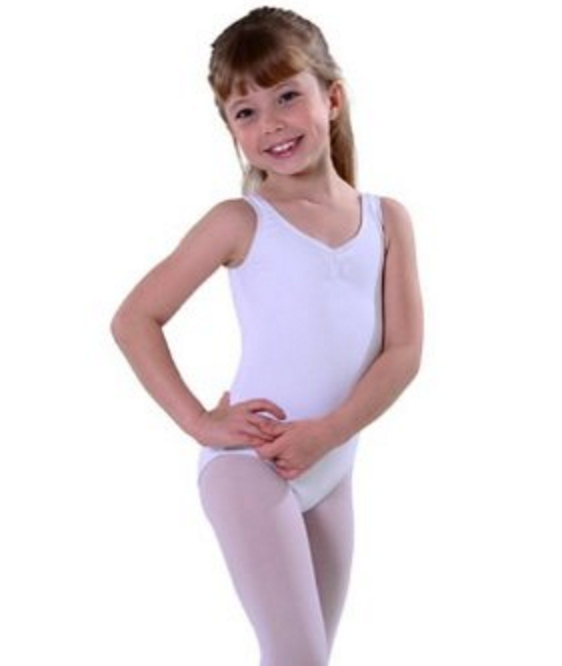
Ballet (or dance) leotards come in many different styles and may be made of cotton, spandex, or occasionally lace, mesh, or velvet.  Dance leos geared toward young children often come in tank, short sleeve, and long sleeve styles.  There are also camisole (spaghetti strap) and ¾ sleeve styles, but they are often geared toward teen and adult dancers.  Little girls starting ballet are usually required to wear soft or classical colors like baby pink, white, or black. 

For ballet, it is extremely important that a dancer be comfortable and able to move easily.  It is also essential to the art that students dress in line with the dress code requirements.  While gymnastics is to some extent about being individual and standing out while in a supportive team environment, ballet is all about fitting in and following the rules for a seamless production.  Part of basic ballet training is learning how to be in costume and move in unison with other dancers. 

Also, dance leotards often have details like rhinestones, ribbons, lace, and strappy backs that look super cute.  Because ballet/dance does not use tumbling equipment, these decorations are safe.  Wearing a leotard with decorations to gymnastics or while using tumbling equipment can be dangerous (students can get caught on bars, etc) and lead to injury.

The bottom line is that it is not acceptable to wear a gymnastics leotard to ballet or a ballet leotard to gymnastics.  Unfortunately, gymnastics leotards are much more expensive than ballet leotards (a basic gym leo is about $30, even for little kids, while a basic cotton ballet leo runs about $13 for toddler sizes).  However, the spandex fabric of gymnastics leos usually washes better and holds its shape and color for longer than basic cotton ballet leotards. 

If you are on a very tight budget, it is much wiser to dress a young gymnast in a simple one-piece swimsuit (with tank straps and no logos or sewn-on details) than a cotton dance leotard.  Kids’ swimwear generally comes in bright colors and is made of slick spandex, so it performs well and does not look out of place in a gym.  Of course, I recommend eventually investing in a nice gym leo or two if the little one sticks with gymnastics.

If the dancer is not jazzed about her plain ballet leotard, help her dress up her look a little with a bedazzled bun cover or chiffon skirt if the dress code allows.  You may also show her some pictures of pre-pro students in class and point out that they all have to wear their uniforms too.


Sunday, September 4, 2016

How to put your name in your dancewear


Many dance schools require all students in the same level to wear the same uniform, so a lot of people own and wear (and, unfortunately, loose) the same items.  Most schools recommend that dancers write their names inside their dancewear.  This is the best way to keep track of your items when they get mixed up with other people's dancewear, but it is really difficult to write your name in some pieces.  How do you put your name in a black leotard?  What about on a reversible skirt?  In this post, I'll provide ideas for how you can permanently and stylishly put your name in your dancewear. 

1.       Write your name on the tag.  This is one of the most common and obvious techniques, but there are a few necessary conditions for this to work.  There must be a tag.  The tag must be a light color.  The tag must not be too silky (this causes all inks to bleed badly).  If the tag meets these conditions, use a fine point sharpie or fabric marker to write your name in bold letters on the back of the tag.  Your name should not wash out or bleed when you wash your dancewear, but it will fade over time.  Check the lettering and touch it up regularly to make sure your name is still legible.

2.       If there is no tag, the tag is too silky, or the tag is a dark color, you will have to use another option.  If the item is a leotard or bra, does it have a lining?  Is the lining a light color?  If so, write your name on the lining with a fabric marker.  Be very careful not to press too hard; the ink can bleed through the fabric and show on the outside of the garment. 

3.       If there is no lining or the lining is black, cut a small square (about 1" by 1")of light-colored soft fabric from an old t-shirt and write your name or initials on it with a fabric marker.  Carefully sew this square onto the inside of the garment.  Use thread the same color as the outside of the dancewear piece.  If your piece is reversible, write just your initials on the fabric square (you can use stylish lettering for a fun touch) and carefully sew it to the garment in a location where a logo would normally be (on the hip of a leotard, the back center of a bra, at the bottom of the leg of a pair of shorts, etc.).  Sewing on a nametag is more secure than using stick-on options.  If your garment later becomes a hand-me-down for someone else, use a seam ripper to remove your name tag.  It will come out easily with no reside or damage to the garment.

4.       For a wrap skirt with no tag, use a thin fabric marker to carefully write your initials inside the tie/band at the back of the skirt where it will always be against your body.  If the skirt is black, use the small square method from the previous item and sew it to the inside of the band as if it is a tag.  If you don't really need your name in your skirt, but want to make it slightly unique or different from other dancers' similar skirts, take one end of the tie and slide on a plastic bead (pony beads work best).  Tie a knot in the tie to keep the bead from slipping off.  This will make your skirt recognizable when it is next to several other dancers' similar skirts.  DO NOT use multiple beads, they are noisy and distracting.

5.       If you temporarily have a costume that will eventually be returned to a company or another 
person, tear a small  piece of masking tape or neoprene medical tape, write your name or initials on it, and stick it inside the item.  Be sure to do this with all pieces of the costume (top, skirt, hat, gloves, etc.).  This is also a good way to mark items (boot covers, etc.) as right and left.