Wednesday, March 28, 2018

Who's Mark?


Whether you're new to dance or a seasoned veteran, it's sometimes a little bewildering to have a teacher turn on the music and yell "Mark!"  It's probably especially odd if your name is Mark or you know someone named Mark.  I've witnessed a student ask, "Who's Mark?" more than once, and in advanced ballet, no less.


When a teacher says "mark," (and yes, it really should be lowercase) he or she is inviting the class to listen to the music and casually move through the combination to ensure understanding of the steps and musicality.  Students often mark combinations before performing them in class, and dancers sometimes mark through choreography at the beginning of rehearsal to ensure everyone remembers the steps.


Dancers have individual methods for marking steps.  Some perform all the steps, but with a lower energy level than is required to perform them full out.  Others shorten or simplify steps, like holding a flat passe to represent a pirouette.  Another method is performing the arm movements while standing in place.  Yet another is moving the hands to represent the legs and feet.  Marking does NOT mean do it sloppy or stand still and just listen.


Some teachers have preferences for how students mark combinations, but it largely doesn't matter as long as dancers use the opportunity to ensure they understand the steps, tempo, and musicality for the combination.

Wednesday, March 21, 2018

Beware of ballet-themed products


I'm sure everyone has seen ballerina dolls and pointe shoe-printed birthday party paraphernalia.  Young kids are often drawn to these products, and they can be really fun to play with and use for décor.  However, mainstream products with a ballet theme are often quite fantasized.  They are very different from the real thing, and if children who see or use them are involved in ballet, issues can arise.  I've seen more than one child have an argument with her parents because her leather ballet slippers are pale nude-pink instead of the neon rose she expects.
Here are a few things that ballet-themed products frequently get wrong:


1.      All pink ballet shoes are pale or peachy pink, not bright or dark pink.  From toddler's full-sole slippers to professionals' pointe shoes, no mainstream ballet shoe is brightly colored.  Barbie is notorious for having ballet slippers that are super pink (and often glittery), but most real ballet shoes just aren't made that way.  (Note: Some companies such as Grishko sell pointe shoes with satin dyed hot neon pink.  These are used by professionals for wild costumes for parts like flamingoes in Alice in Wonderland.  Shoes like these are never allowed at ballet schools.)


2.      Shoe ribbons are simple or nonexistent.  Ballet dolls and various illustrations show shoes that have thick (usually dark pink) ribbons attached, and the ribbons often lace up dancers' legs from ankle to near the knee.  I have no idea how this depiction became so ubiquitous.  It's absolutely incorrect.  About 99% of the time, flat ballet slippers do not have ribbons on them.  They are held to the foot with 1 or 2 pieces of stretchy elastic.  Occasionally dancers wear ribbons on their flat shoes for performances, but usually ribbons are reserved for pointe shoes.  The ribbons on pointe shoes are wrapped and tied just around the ankle, and the ribbons are overlapped, not criss-crossed up the leg.  Just about the only time the zig-zag ribbon weave pattern is seen in ballet is on the front of a bodice-never on the leg!


3.      Dancers wear their hair up 99% of the time.  Barbie is again notorious for performing solos and pas de deuxs with long blonde hair curling down her back.  It's common to see ballerina dolls and motifs that show dancers with pigtails or braids.  Barring the occasional character role, ballet dancers wear their hair in tight buns or similar updos on top of their heads.


4.      Wands are rare props.  Lots of ballerina drawings show dancers holding fairy wands.  Many famous ballet roles are fairies, but hardly any of them have wands (or really any props).  If the part involves doing magic or casting a spell, dancers usually use their arms to show this action.  It's also pretty common for the term "fairy" to be just a description of the character's name (such as the sugar plum fairy or dewdrop fairy in Nutcracker) and not relate to any actions she performs.


5.      Tutus are usually not pink.  There are a lot of tutus in ballet, but they are quite different from those on dolls.  Longer romantic tutus are more common than plater tutus in most productions, and hardly ever are any of them pink.  The only pale pink tutus I know of are usually worn by Nutcracker's sugar plum and Sleeping Beauty's Aroura.  The only time I've seen bright pink tutus is in Nutcracker's waltz of the flowers and some versions of Nutcracker's mirliton variation.  That's not to say there isn't a lot of pink in other ballet costumes (like the bodice of a peasant in Giselle or the unitard of a flamingo in Alice), but the vast majority of tutus are actually white.


Wednesday, March 14, 2018

Dance terms: Classes, lessons, and rehearsals


Every dancer has that parent or friend who asks things like, "When does your practice start?"  Trust me, I know how annoying it can be.  It's nice that they equate dance with sports (it is a sport, after all), but it sounds so funny to dancers.  Even though there is soccer practice and football practice, there is no ballet practice.


Here's the breakdown:


A dance class is where a group of students complete movements and combinations at the direction of a teacher.  Classes are usually pre-scheduled on a certain day and time and reoccur for a period of time (such as every Monday at 6pm from August through December).  Classes that are scheduled last-minute (such as a class held for dancers to warm up right before a performance) are called pick-up classes.  A class held one time with a well-known or celebrity instructor is called a master class or a workshop.


A lesson is a one-on-one (or two-on-one if it's ballroom or pas de deux) interaction with a student (or couple) and a teacher.  The term lesson is only used in dance if it's describing a private lesson (also sometimes just called a private).  Private lessons may be structured like classes with specific warm-ups, combinations, and cool-downs, or they may be more instructive (like a teacher shows the student a new step or focuses on improving one thing).


A rehearsal is a session with one or multiple dancers and either a director, choreographer, teacher, or rehearsal assistant.  During rehearsals, dancers learn and practice choreography to prepare for performance.  Even though dancers do practice their choreography, they rarely use the word practice to describe what they are doing.  Practicing is usually called running (as in, "we will run the dance twice").  The only time the word practice is used is when referring to a very specific action, usually involving sets or props (like, "you two need to practice handing the Nutcracker to each other").  Even then, it's just as common to hear a teacher say work on instead of practice.

Wednesday, March 7, 2018

Leotards for good posture


If you have rounded shoulders, you probably work hard to stand up straight and hold your posture.  Strong muscles are most important in building good posture, but believe it or not, the style of your leotard can also play a big part.


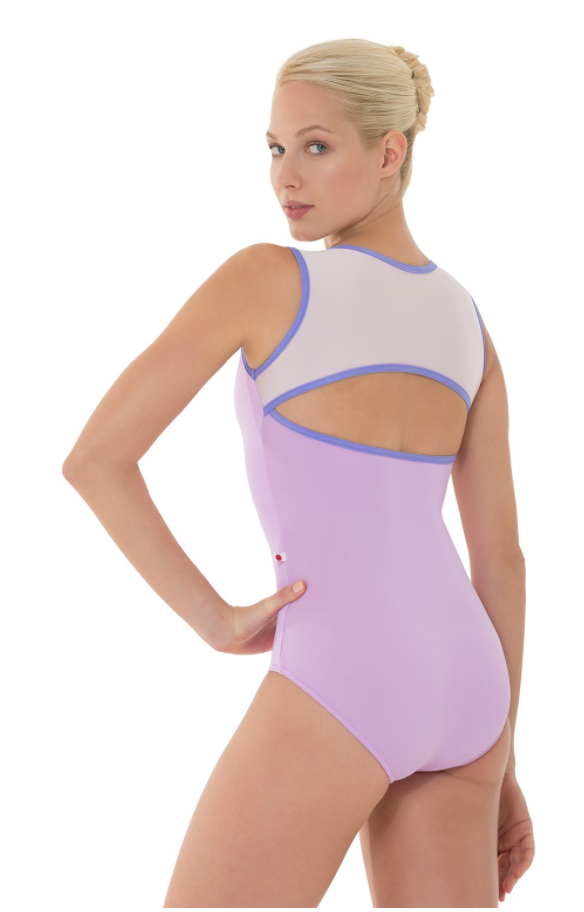
Halter, racerback, and high back/lower front (such as Yumiko Becky) styles all have a tendency to pull the shoulders forward.  The tension of leotards' tight fabric physically pulls on the body, and this provides resistance that can make it more difficult to maintain good posture.  High back/low front styles are especially tough because they also cover the back, making it difficult to see back muscles working and drawing attention to any slight hunch.  If you struggle with posture, consider avoiding these styles, especially for situations like auditions.


Low back/high front styles that leave most of the back open (such as Yumiko Sofiane) are best for encouraging good posture.  They lay flat across the front when the shoulders are pressed down and the chest is open, and low scooping backs show off the shoulder blades.  Even if your back is naturally curved (mine is), leos like these let other people see your hard-working back muscles rather than just the outline.  Directors are less likely to comment on your posture if they are able to see that your muscles are working.  Styles like these are perfect for auditions and rehearsals when you want to look strong and confident.

Wednesday, February 28, 2018

Hair Trouble


When you're doing your hair in a bun (or otherwise pulling it back for performance), you can sometimes run into issues that cause anxiety and take time to correct.  In this post, I'll provide some tips for quickly and easily fixing common hair issues.


For kids and recitals:


1.       My daughter's hair is too short for a bun OR my son's hair is too long to leave down.  As an assistant teacher for children's ballet, one of my jobs is preparing students for their class photos and recital performances.  I often help with hairstyles.  For young students (or really anyone participating in an informal performance), the goal is to have all students look similar, be able to see, and avoid distractions.  With students who can't do their hair in buns, it's most important to pull back any bangs and keep hair away from the face.  Gel, bobby pins, and thin neutral-colored headbands all work well.  Regardless of the student's gender or hairstyle, as long as the hair is neatly secured in a way that it won't fall in the face, it's good enough for the informal stage.


2.      My child's hair is very fine or flyaway.  In this case, gel is going to be your best friend.  You can also use a mixture of conditioner and water if gel seems too harsh.  Lightly gel or spray the hair with the conditioner mixture before combing it back for the bun or other style.  This should give the hair a light "crunch" factor and keep it from falling out of the style.  Gelling before the styling step works much better than using hairspray after the style is in place.  After making the bun or hairstyle, try to keep your child from lying down, running around, or going outside in the wind.  All of these factors will make the hair more likely to fall out of the style.


For professional-quality performances:


1.      My hair is really curly and difficult to smooth down for a bun.  Slightly dampen dry hair with water or leave-in conditioner, then apply a little bit of gel from the roots to about 6" down.  Use a gentle brush or comb (I like the wet brush or tangle teezer for this) to brush through only the area you gelled (roots to 6" down).  Once that part of the hair is smoothed, put hair in a ponytail.  You should have a sleek head and curly ponytail.  Twist the ponytail and form your bun.  It doesn't matter if the hair is curly going into the bun; the tightly coiled hair will look smooth from the audience.  Cover it with a hairnet and secure with bobby pins to prevent flyaways.


2.      My hair is thick/sleek/heavy/slippery and tends to fall out of a bun.  Brush hair back and put it in a ponytail.  Use an elastic with rubber grips to tie the ponytail.  Rather than wrap the hair in a bun, it may be more secure to use a donut to form the bun.  Slide the donut onto your ponytail, spread your hair over it, and secure it with another rubber-grip elastic.  Wrap the loose ends of hair under the donut and secure with bobby pins.  Cover the bun with a hairnet and add more pins and hairspray for security.


3.      My hair got caught on Velcro and a little piece that's supposed to be sleek is sticking out.  Don't fret or try to redo your whole style if you don't have time.  Use a spoolie, brow comb, or toothbrush to gently comb that piece back into place (it's really surprising how well this works).  Spray on a liberal amount of hairspray and/or poke in a mini bobby pin to keep the piece form popping out again.


4.      I took off my warm-up or costume over my head, and now I have major static.  Do not use a brush here, it will only make things worse.  Spray hairspray on your hands or a paper towel and gently pat your hair.  This should make the stray strands lay flat again.  Give your whole style an extra spritz to make sure the flyaways don't pop up again.


5.      I have to change headpieces during a quick change.  The anxiety associated with a quick change makes it super challenging to find all the bobby pins in your headpiece, remove them without pulling pieces out of your bun, and securely attach the new one.  The best way to do this is to get a friend to help.  Sit down and have your friend stand over you so she can see the top of your head.  Since she has a good view, she can pull the bobby pins straight out and remove your headpiece quickly.  Depending on how much time you have, your friend can then attach your new headpiece while you work on something else, like changing shoes, or you can attach the new headpiece yourself.

Wednesday, February 21, 2018

Ballet Freakonomics


Freakinomics took the world by storm several years ago with a groundbreaking book that took very different things and showed how they are similar and work together to solve problems (such as how is a child's car seat like a DVD player).  This post will examine some common ballet and dance dilemmas and explain unusual yet effective solutions.


Problem:  I feel wobbly en pointe.
Unique solution:  Pilates

The number one solution your teacher and friends will probably offer is a slew of strengthening exercises for feet and ankles.  While these will help, something else will give you a faster and even more beneficial fix:  Pilates.  A full Pilates workout strengthens the arms, legs, back, and core.  While strong ankles are necessary for pointe, they will not stop you from wobbling if everything else is weak.  A strong core is the best thing to keep you stable.  Try 20 minutes of Pilates daily for a month and you will see and feel a difference (and keep it up forever after that!)

Problem:  I have a sore muscle.
Unique solution:  Keep on moving.

It's easy to overwork muscles like calves in intense classes.  Most of us have been trained to RICE (rest, ice, compress, elevate) at any sign of pain, so an ice bath and relaxing evening may be your first thoughts.  Actually, in situations where your muscle is just tight and overworked, not sprained or torn, heat and continued activity are much more beneficial.  Make your bath warm, and engage in some walking and/or stretching before turning in.

Problem:  I need to lose weight.
Unique solution:  Don't count calories.

Once you've determined it's safe and healthy for you to lose a few pounds, you're probably thinking about cutting down on fat and calories.  Actually, the best way to get results is to leave those things be.  Focus on how you feel, eat to meet your needs (hunger, activity, etc.), and try to consume wholesome food.  Worrying about calories and fat can add stress, which makes it more difficult to lose weight.

Problem:  I want to cross train.
Unique solution:  YouTube

Your first thought is probably to purchase a gym membership.  While there's nothing wrong with working out on the treadmill, fitness classes are usually more fun for people already used to the structure of dance class.  There are thousands of fitness classes available for free on YouTube and through fitness apps.  With weird rehearsal schedules, it's much more convenient to go through a HIIT series or yoga flow in the living room or backyard than trek to the gym in rush hour.

Problem:  I want to look bold and stylish in class.
Unique solution:  Ignore the trends.

To be stylish, you should get a patterned wrap skirt like everyone else has so you can fit in, right?  Wrong!  Start a new trend with something unique, like a solid colored skirt or knit shorts.  Trendsetters are seen as unique and confident, while those who wear only clothes that are already popular are more likely to be followers.

Wednesday, February 14, 2018

Spacer Roundup


When ballet dancers wear pointe shoes, some use spacers to help align their toes within their shoes.  Like many things in the dance world, there are many options for spacers.  This guide will go over the most common styles and how they are used.


Classic spacers


These are the most common type of spacers used in the dance world, and they are also commonly used by athletes like skiers and hikers.  They are great for filling a gap or providing comfort between the first and second toes.  What I find a bit nonsensical, though, is that these are probably the least effective in preventing and correcting bunions.  Because these spacers are short in height, the big toe can still curve inward over the spacer.  Due to this, I highly recommend this type of spacer to dancers who need to fill a gap between the toes, but I don't think it's the best choice to correct bunions that are already present.


Oversized or "P" spacers


These big spacers are perfect for keeping the big toe from curving inward.  Because they are usually as tall as the big toe, it can't curve over the spacer.  Nothing is more effective for preventing or correcting bunions.  However, because these spacers are very large, they take up a lot of space in shoes and may not work well for small-boned dancers.


Mini spacers


These are meant to go between toes other than the big and second toes.  If you get blisters between your toes or have pinky-toe-side bunions, mini spacers can be a big help.  When using them, you may need to add some tape over and/or under the toes you place the spacer between in order to keep it from falling out.


Wedge spacers


Wedge spacers can be a good alternative to oversized spacers for younger or smaller dancers.  They also prevent the big toe from curving inward, but they are usually made of softer and more flexible gel material than oversized spacers.  Tape may need to be used with these as well since they are less secure between the toes.


Homemade spacers


If you think you might benefit from spacers but don't want to buy them yet, you can make your own temporary ones.  A foam wedge makeup sponge can be a good trial run for a wedge spacer.  A cotton ball or two slipped between the first and second toes can imitate the feel of a classic spacer.  Small ovals of craft foam can be a slightly-less-flexible alternative to mini spacers.