Wednesday, August 10, 2016

Guide to piercings, tattoos, and other body art for classical dancers


If your main dance style is in the classical or “stage” realm, it can be difficult to have body art (including tattoos, piercings, and unnaturally colored hair).  Most directors expect dancers to be able to perform as either old fashioned or universally recognizable characters who do not have body art.  Whether you are considering getting body art or you already have it, this guide will provide some tips on how to manage it in a classical dance setting.

Some types of body art are not a big deal.  Any tattoo or piercing that is concealed under regular dancewear (like a belly ring or tattoo on the hip) or is not outwardly visible to begin with (tongue piercing, etc.) is usually no problem because it will rarely be seen.  Occasionally a costume may show the navel, but it is rare enough that most directors will not see belly rings and hip tattoos as a problem.

Earlobe piercings (up to about 3 per ear) on both men and women are completely acceptable as long as they can accommodate small subtle post earrings and are not gauged.  Any ear cartilage piercing short of an industrial is also fine as long as it can accommodate subtle post jewelry (not rings).  The same goes for lip and nose piercings that take a secure piece of post jewelry and do not exceed about lmm in size.

Any ear or facial piercing that involves a ring becomes noticeable from the audience as well as dangerous in partnering situations.  It is far too easy for jewelry to become stuck on a costume or catch on your partner’s fingers.  This can damage clothing and really hurt you and other people. 

A small visible tattoo an area like the back or arm is usually fine as long as it can be covered for performances.  One tattoo on the shoulder or upper back can easily be covered with heavy-duty makeup and/or a costume.  For women, leg tattoos are a big no-no; it is very messy to cover tattoos with makeup and then put on tights without making a huge mess.  Top-of-the-foot tattoos are better, as they will almost always be concealed in a shoe or other footwear.  In general, large and brightly colored tattoos are much harder to deal with than small, subtle ones.  If you are thinking of getting a tattoo, it is easiest to conceal one that is smaller than 3 inches, done in one color, and located on a part of the body that is either usually covered with dancewear or can be easily covered in makeup.

As far as hair color goes, it is usually fine with artistic directors if you dye your hair any color within the spectrum of natural human hair colors.  If you want to push the limits, try pale blonde, jet black, or bright auburn before taking on pink or blue.  If you go with an unnatural color, you will have to somehow cover it for performances.  Sometimes wigs and wig stylists will be available to help cover your color with fake hair, and other times the director will simply demand that the purple be gone by tomorrow.  If you are okay with your bright color being short lived, then dye away (but be aware of how dying your hair can damage it).  If you can stand to be a bit more subtle, try just a streak of green or pink and leave the rest of your hair natural.  A streak can easily be twisted into a bun or covered with mascara to conceal it from the audience without having to go with a wig.

If you already have gauges, facial piercings, visible tattoos, or unnaturally colored hair, don’t despair.  You simply need to display humility and professionalism at auditions and when working with new directors.  Always follow dress codes and wear the appropriate uniform for auditions.  If you can, choose dancewear that covers tattoos (such as a ¾ sleeve leotard if you have arm tattoos).  Wear subtle jewelry like small gold, silver, or diamond labrets or posts in piercings, or insert clear plastic spacers.  No matter your hair color, style it neatly and secure it away from your face.  Try your best to keep your appearance from distracting from your dancing. 

If a director approaches you about your appearance, think about what you would be willing to change.  Offer temporary fixes (like putting makeup on tattoos and using plastic spacers in facial piercings) where you can.  You are never obligated to change your appearance for a director, but remember that it is the director’s right to ask you to look a certain way (within reasonable limits) to fit the part.


Body art in classical dance is more common than you may think.  However, the key to making it work is keeping modifications simple enough to hide during performances.

Wednesday, August 3, 2016

What kind of shoes do I need for this style of dance?


If you go to the dancewear store to find shoes for your first dance class, it is important to know the general name and appearance of the sort of shoe you are looking for.  Sometimes having the wrong shoe will impede your ability to participate in class, so it’s important that you get exactly what the dress code requires.  Additionally, dance store workers will not understand what you need if you do not use exact terminology to describe the shoes you need.  This illustrated guide will help you associate a name with a look with a style of dance.
Split sole ballet shoe
full sole ballet shoe


Pointe shoes

Ballet: ballet shoes
Usually young children wear full sole leather ballet shoes.  Kids over age 10, teens, and adults can wear split sole leather or split sole canvas ballet shoes.  Only very advanced dancers wear pointe shoes, a special kind of ballet shoe made of satin and paste that allows a dancer to stand on her toes.

Jazz shoes


Jazz: jazz shoes
These soft canvas or leather shoes feature a split sole and low foam heel that allows dancers to perform all sorts of moves with ease.


Mary Jane style
Oxford style


Tap: tap shoes
Little girls usually wear shiny mary-jane style shoes.  Young boys, older children, teens, and adults wear lace-up oxford tap shoes.  Tap shoes are usually divided up by level and price point.  “Beginner” or children’s shoes usually cost under $50, intermediate shoes (recommended for adult or larger-bodied beginning dancers) usually cost $50-$100, and advanced shoes usually cost $100 to $200.

Women's character shoe
Women's Rhythm ballroom shoe
Men's ballroom or character shoe
women's teaching shoe


Ballroom/Latin: ballroom shoes, Latin shoes, practice shoes, dance sneakers, character shoes, jazz shoes, or teaching shoes
For your first lesson, I recommend getting character shoes.  These dress-style shoes come in varieties for men and women, and they have hard leather soles that accommodate wear on both a dance floor and on the street.  You can wear them as dress shoes in addition to dance shoes (just clean them regularly).  Character shoes are pretty comfortable, not too expensive ($50 or less for women’s, $80 or less for men’s), come in different colors and heel heights, and can also be used for other activities like musical theater.

If the dancewear store offers ballroom practice shoes, they are a great choice because they are comfortable and can be used for any type of ballroom or Latin dance.
Dance sneakers and jazz shoes are also a good choice for dancers who have a difficult time with hard dress shoes or high heels.  These soft, comfy shoes look more casual, but perform very well on a dance floor.

For female dancers who want a dressy look but can’t take a hard shoe or heel, teaching shoes are ideal.  Usually worn by ballet instructors, these shoes look like jazz shoes, but with low vamp and a 1” foam heel.  The overall appearance is of a soft leather pump.


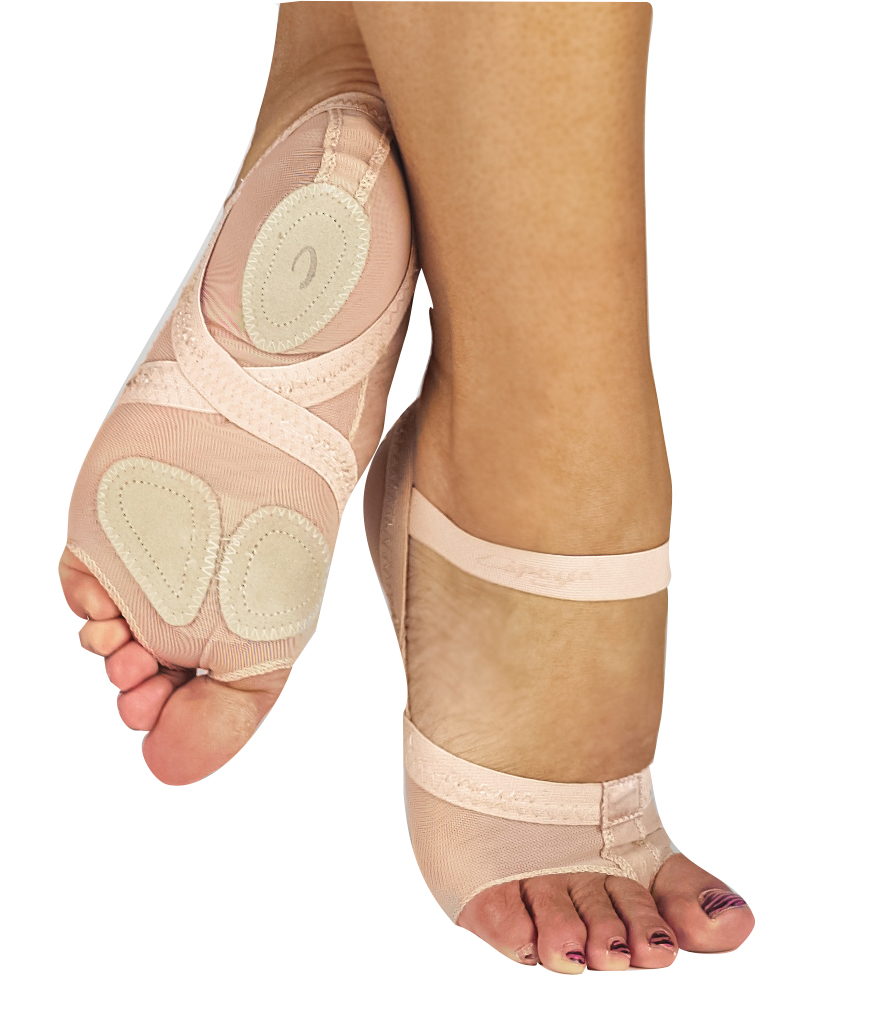
Modern: modern footwear (half-soles, foot undies, etc.), ballet shoes, jazz shoes, socks, or bare feet. I recommend half soles or foot undies for modern since they protect the feet from blisters and floorburn while leaving a barefoot look.  Check with the studio on what is allowed before making any purchases.  See my full guide to modern footwear here.


Hermes Sandals

Belly dance: modern footwear, jazz shoes, Hermes sandals
Usually belly dance is done barefoot, but sometimes performances are done outside or on surfaces that hurt unprotected feet.  If you plan on performing, it can be good to practice in shoes or footwear so you are used to the feeling.  Hermes sandals are the most traditional, and look like part of most belly dance costumes.  However, they are usually very stiff and expensive for what you get.  Modern footwear protects just the ball of the foot, but keeps the barefoot look.  Jazz shoes are the most supportive, but sometimes detract from the overall look.

Tumbling shoes (also called vaulting shoes or acrobatic/acro shoes)


Acrobatic: Tumbling shoes, barefoot
You definitely want to check with the studio here.  Some schools require footwear for acro dancers, and others do not allow footwear.  Tumbling shoes (also called vaulting shoes or acro shoes) resemble jazz shoes, but have a flat rubber split sole instead of a hard foam heel.  This sticky rubber does not slide on the floor, which helps dancers land tumbling passes and gymnastics moves without skidding.  It is dangerous to wear ballet shoes, jazz shoes, or other footwear for acro classes because these types of shoes are meant to make sliding across the floor easier rather than more difficult.  Tumbling with bare feet can also provide a similar ability to stick with out sliding.

Dance sneakers

Hip-hop: dance sneakers
Dance sneakers are your best choice for hip-hop.  Clean streetwear sneakers and jazz shoes also work, but not quite as well.  Dance sneakers for hip-hop usually have chunky molded plastic split soles and soft foam cushioning.  These attributes help dancers articulate their feet and absorb shock from high impact movements.

Women's character shoes
Jazz shoes

Burlesque or musical theater: character shoes or jazz shoes
Depending on your specific needs and what kinds of performances you might do, either character or jazz shoes will suit your needs.  It is often easier to learn choreography in softer, lower-heeled shoes, but character shoes are preferred for many productions. 


Drill team, pom, or color guard: jazz shoes
Almost all “dance team” styles require jazz shoes.  The softness of the shoe and durability of the sole make them good for most dance surfaces, easy to maneuver, and flattering to different costumes.  Do be sure to check with the studio or team before purchasing; specific colors and even brands/models are often required.

Cheer shoes
Cheerleading: cheer shoes (sneakers)
Cheer shoes are white lace-up sneakers that are built to absorb shock from high impact movement.  Some have a spin spot on the ball of the foot.  There are different varieties for bases, fliers, etc, but many dancewear stores carry only one basic type.  Sporting goods stores or online cheerleading retailers have more options.

Dance Sneakers

Line dancing, square dance, or country western:  dance sneakers, possibly character or jazz shoes.  The chunky molded plastic sole of a dance sneaker make gliding and turning very easy.  Sneakers are also very comfy, which contribute to ease of movement and shock absorption.  Dance sneakers are usually black and resemble other athletic shoes, so they go well with jeans and dance pants.  If you desire a dressier look, low-heeled character shoes or even jazz shoes will also perform well.
Dance Sneakers

Zumba or dance fitness: dance sneakers

Regular sneakers are not ideal for dance fitness classes because their soles are too sticky.  Trying to slide and turn in them can damage ankles and knees.  Dance sneakers glide and turn better, so they are a more appropriate choice.

Sunday, July 31, 2016

July Favorites


Here's what I've been loving in July!

Dancewear:

Machine generated alternative text: A
ç
Gaynor Minden Bamboo Knit Shorts (available from dancer.com)

These shorts are made of rayon from bamboo, so they are super soft and comfy.  In the warmer months, I like to wear light warm-ups that allow me to cover up and get my body moving without making me super sweaty.  These shorts are great for warming up the hips without being too hot and clingy.  They are also breathable, which makes them a better choice than trash bag shorts for super hot months. 

Machine generated alternative text: ,
—4
P
L
d
Forever 21 ribbed V-neck Crop Top (available at Forever21 stores and on forever21.com)

I like wearing crop tops over leotards on my way to and from the studio.  They are also a great choice to cover an open back leo if you have Pilates or modern class right after ballet.  Tops like this one are great for summer class because they are lightweight and have large neck openings for easy on and off without messing up hairstyles.
Machine generated alternative text: F
/
Sketchers Go Walk 3 Super Sock Slip on Sneakers (available at sketchers.com and at some Sketchers retailers)

These shoes are so comfy.  The insole is made of super springy yoga mat material, and the sole features treads shaped for optimum alignment and stabilization.  The insides of the shoe is lined with soft material, and the heel area is cushioned.  If you like closed-toed shoes, these are perfect to throw on after class (even if your feet are blistered and swollen).  If you are doing any city walking or sightseeing as part of a tour or intensive, these shoes are awesome in terms of comfort and support.  The style isn't bad either. 

Machine generated alternative text:
Skinfood Black Sugar Wash Off Mask (available from amazon.com)

This skincare mask is from the Korean beauty brand Skinfood, which specializes in nourishing the skin with effective and affordable products.  This mask exfoliates and moisturizes the skin for a glowing complexion.  In the summer, I get clogged pores from sweating a lot in class.  I use this mask twice a week to clear my pores and keep acne from developing.  This mask is most effective for dry and acne prone skin, but it is suitable for all skin types including sensitive skin. 

Machine generated alternative text:
Julep Jelly Nail Polish in shade "Ming" (available from julep.com)

I like having neatly polished nails, and my nails feel stronger when they are painted.  I usually stick to neutral colors (most dancers do), but a little color once in a while is lots of fun, especially for summer.  Julep's Jelly formulas are sheer, so you can get a wash of color that is not overwhelming.  I love this lilac pink shade because it's close to a neutral, but it pops a little.  This color also looks good with all skin tones.  It does not appear super pale next to darker skin.

Machine generated alternative text: ______
_________  
\ cuiIivco....
L _-.r-  - —- !
41 ——-—-• —
r PLAPÃ…8AP/ —
! ______
_1, j-9 •OAITID NUT lOLL
f
uberj
I ADDLI TUINOVIN /
. .-
Uber LaraBars (available at most grocery stores)

Like many dancers, granola bars are a staple in my diet.  I have been trying out different bars (usually based on what is on sale at my local grocery) to see what I like best.  These are a real winner for me.  These bars contain an average of 5 grams of protein, which isn't a ton, but it's enough to make a snack filling and nutritious.  With flavors like coconut macaroon and cherry cobbler, these bars can be breakfast, snack, or dessert.  The bars contain limited natural ingredients, so they are super healthy and friendly to gluten free and dairy free diets.

Wednesday, July 27, 2016

Leotards are not swimsuits!

I’ve seen a lot of kids run into the dancewear store, see a rack of leotards, and exclaim “bathing suits!”  I’ve even seen parents look a little perplexed when they see bright, shimmery spandex gymnastics leotards. 

Dancewear stores do not sell swimwear.  Leotards often resemble one-piece swimsuits, but they are not meant to be worn in the water.  Even spandex leotards are not constructed to perform well in a fully-submerged or chlorinated environment.  The stitching may dissolve or the fabric may bleach if exposed to chemicals found in many swimming pools.  Brightly colored gymnastics leotards sometimes resemble children’s swimwear, but remember that dancewear stores do not sell bathing suits.  If your child tells you that he or she sees a swimsuit in the dancewear store, gently explain that it is a leotard.  Additionally, if your child wants to wear her leotard as a swimsuit, don’t allow her to do so.  It will most likely damage the garment.


If you are in the market for a decorative athletic swimsuit for something like competitive diving, the dancewear store is not the place to look.  Try a sporting goods store instead.